hip impingement, athlete, young, hip pain, labral tear
§
Femoroacetabular impingement (FAI) and labral tears are common causes of hip pain, particularly in athletes and young adults. These two conditions are often linked: the mechanical impingement eventually damages the protective structures of the joint.
1. What is Femoroacetabular Impingement (FAI)?
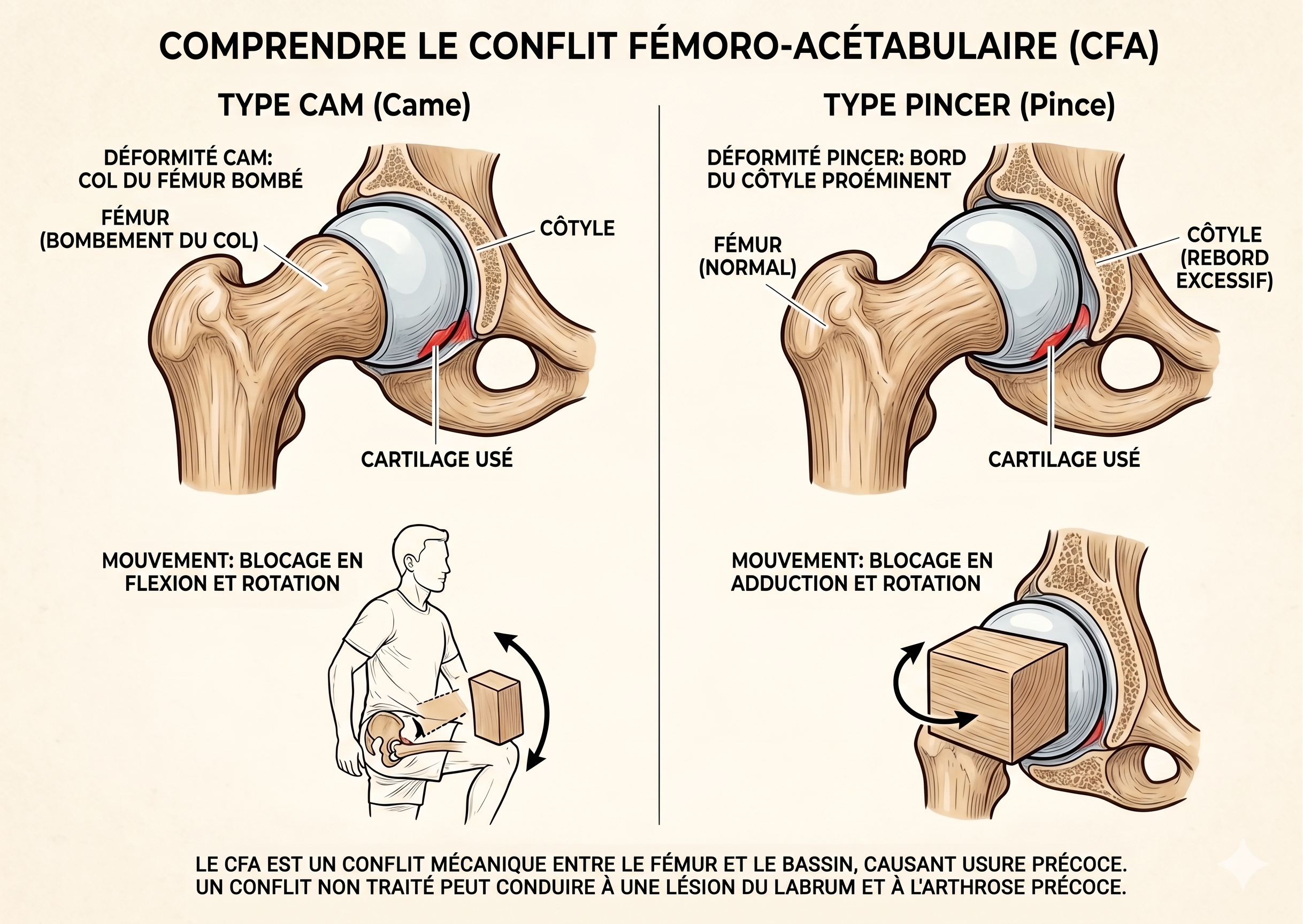
Normally, the hip functions like a ball joint (the femoral head) rotating perfectly within a socket (the acetabulum). In the case of FAI, a morphological abnormality of the bone causes abnormal contact ("bumping") during certain movements.
There are two main types of impingement:
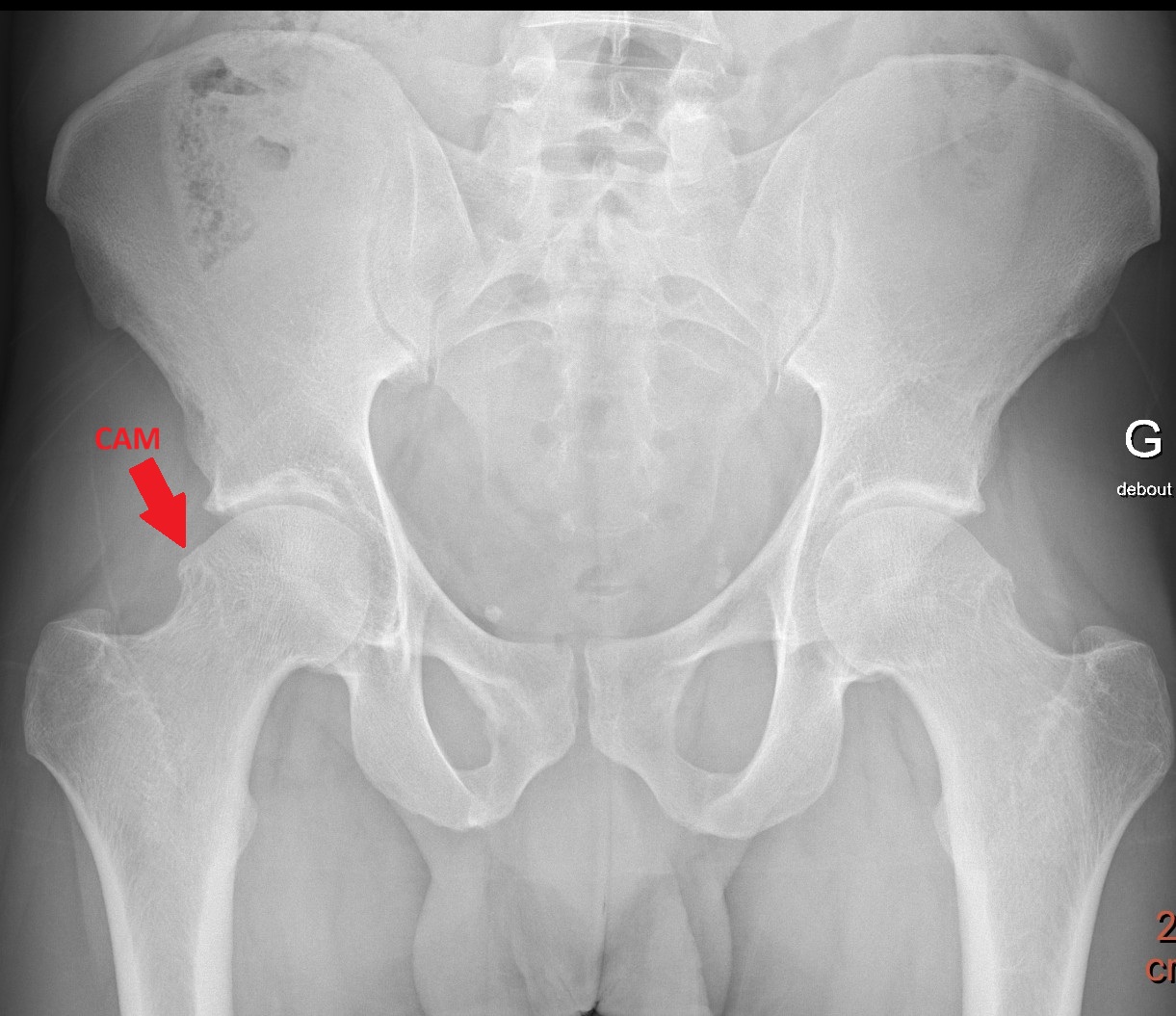
"CAM" effect: The femoral head is not perfectly round. It has a bony protrusion at the junction with the neck. During flexion, this bump forces its way into the socket.
"Pincer" effect: The socket (acetabulum) is too deep or covers too much of the femoral head. It impacts the femoral neck like a pincer.
2. Labral Tears: The Direct Consequence
The labrum is a ring of fibrocartilage (similar to the meniscus in the knee) that surrounds the rim of the hip socket. It acts as a "seal" and stabilizes the joint.
When femoroacetabular impingement is present, the labrum gets "pinched" or crushed with every large-amplitude movement (flexion, internal rotation). With repeated stress, the labrum can:
Become inflamed.
Develop a tear.
Detach from the bone (avulsion).
3. Symptoms and Warning Signs
Patients typically describe pain located in the groin crease, sometimes on the side of the hip or in the buttock.
Groin pain: The patient places their hand in a C-shape over the hip to indicate the painful area.
Pain with prolonged sitting: Typical of impingement that "pinches" during flexion.
Locking or clicking: A sensation that something is catching inside the joint (often a sign of a labral tear).
Pain during sports activities: Football, hockey, tennis, martial arts, or dance.
4. Treatments
Conservative treatment: Relative rest, modification of sports activities, anti-inflammatories, and especially physical therapy to strengthen the hip's stabilizing muscles.
Injections: Corticosteroid or hyaluronic acid injections to calm inflammation.
Surgery (Arthroscopy or Open surgery): If pain persists, surgery may be necessary to "shave down" excess bone (osteoplasty) and repair or reattach the damaged labrum.
Expert advice: Untreated femoroacetabular impingement can promote the early onset of hip osteoarthritis, as the cartilage eventually wears down due to repeated impacts.

:quality(92):sharpen(0.8,0.6,true)/https%3A%2F%2Forthopedie-zhiti.ch%2Fuploads%2Fpathologies%2Fgemini-generated-image-2dfe3u2dfe3u2dfe-69ea181ce1fd3928694137.png)