
:quality(92):sharpen(0.8,0.6,true)/https%3A%2F%2Forthopedie-zhiti.ch%2Fuploads%2Fpathologies%2Fgemini-generated-image-dgpzudgpzudgpzud-69ea0228caf81716045904.png)
Pathologies
Foot Arthritis
Foot osteoarthritis is a degenerative pathology resulting from cartilage wear. Contrary to popular belief, it does not affect just one area: the foot is a complex structure composed of 26 bones and numerous joints that can be affected simultaneously or separately.
Here is an overview of the main locations of osteoarthritis in the foot and ankle.
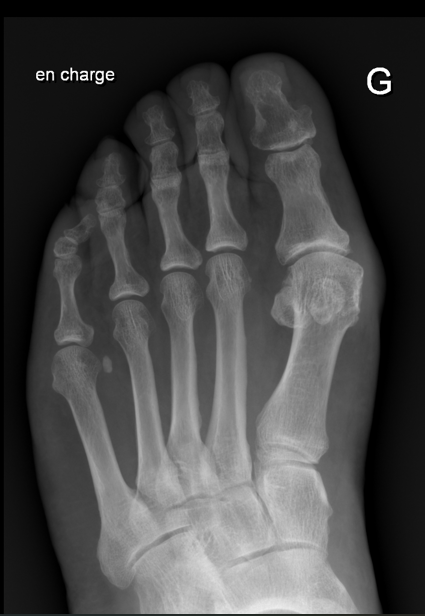
1. Osteoarthritis of the big toe (Hallux Rigidus)
It is one of the most common forms. It affects the metatarsophalangeal joint (at the base of the big toe).
- Symptoms: Progressive stiffness that makes walking painful, especially during the "propulsion" phase (when pushing off the toe to move forward).
- Consequence: The appearance of small bony growths (osteophytes) on the top of the foot, often called "parrot beaks," which can make wearing shoes difficult.
2. Osteoarthritis of the Lisfranc joint (Midfoot)
The Lisfranc joint is located at the junction between the metatarsal bones and the tarsal bones (the instep).
- Location: It manifests as pain on the top of the foot.
- Specificity: This osteoarthritis is often the result of an old trauma (severe sprain, fracture) or a collapse of the plantar arch (flat foot). It can make wearing tight shoes very uncomfortable.
3. Subtalar Osteoarthritis (Hindfoot)
It is located below the ankle joint, between the heel bone (calcaneus) and the upper bone (talus or astragalus).
- Impact: This joint allows lateral twisting movements of the foot. When affected, walking on uneven terrain (cobblestones, sand, grass) becomes very unstable and painful.
- Common cause: It often occurs after a heel fracture or due to a major architectural disorder of the foot.
4. Ankle Osteoarthritis (Tibio-Tarsal Joint)
Less common than hip or knee osteoarthritis, it is nevertheless very debilitating.
- Origin: In the vast majority of cases (approximately 70 to 80%), it is post-traumatic. It follows an old malleolar fracture or poorly treated repeated sprains that have created chronic instability.
- Sensation: A deep pain and stiffness that limits upward flexion of the foot.
Summary of symptoms and management
Symptom
Description
Mechanical pain
It increases with effort and subsides at rest.
Morning stiffness
Stiffness that requires a few minutes of movement to fade.
Swelling
Inflammatory flare-ups can cause the joint to swell.
Deformity
Change in the appearance of the foot over time.
Important note: Treatment generally involves wearing orthopedic insoles (plantar orthoses) to relieve painful areas, choosing appropriate footwear (e.g., rigid soles for the big toe), and sometimes injections. In the most advanced cases, a surgical solution may be considered.