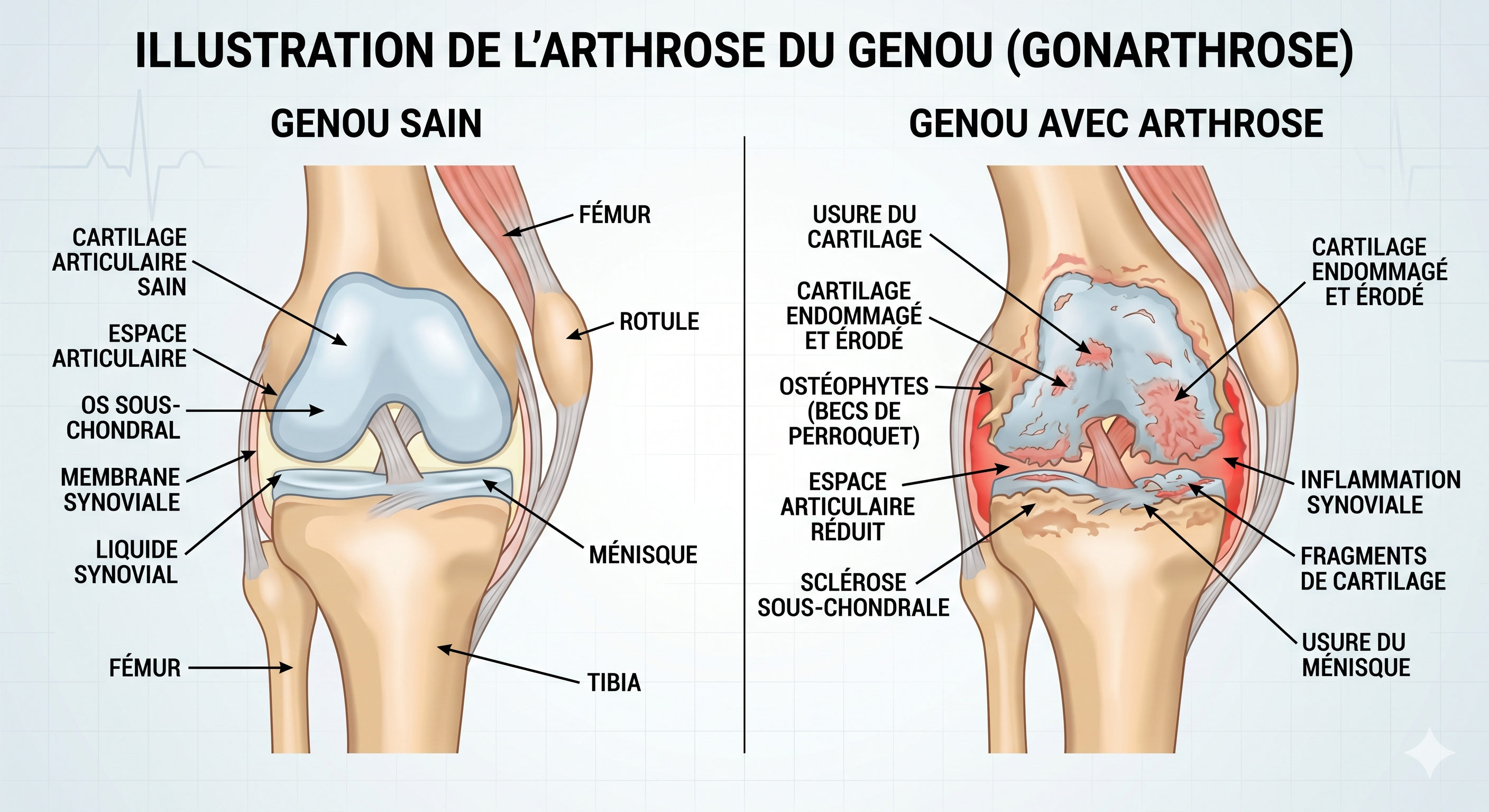
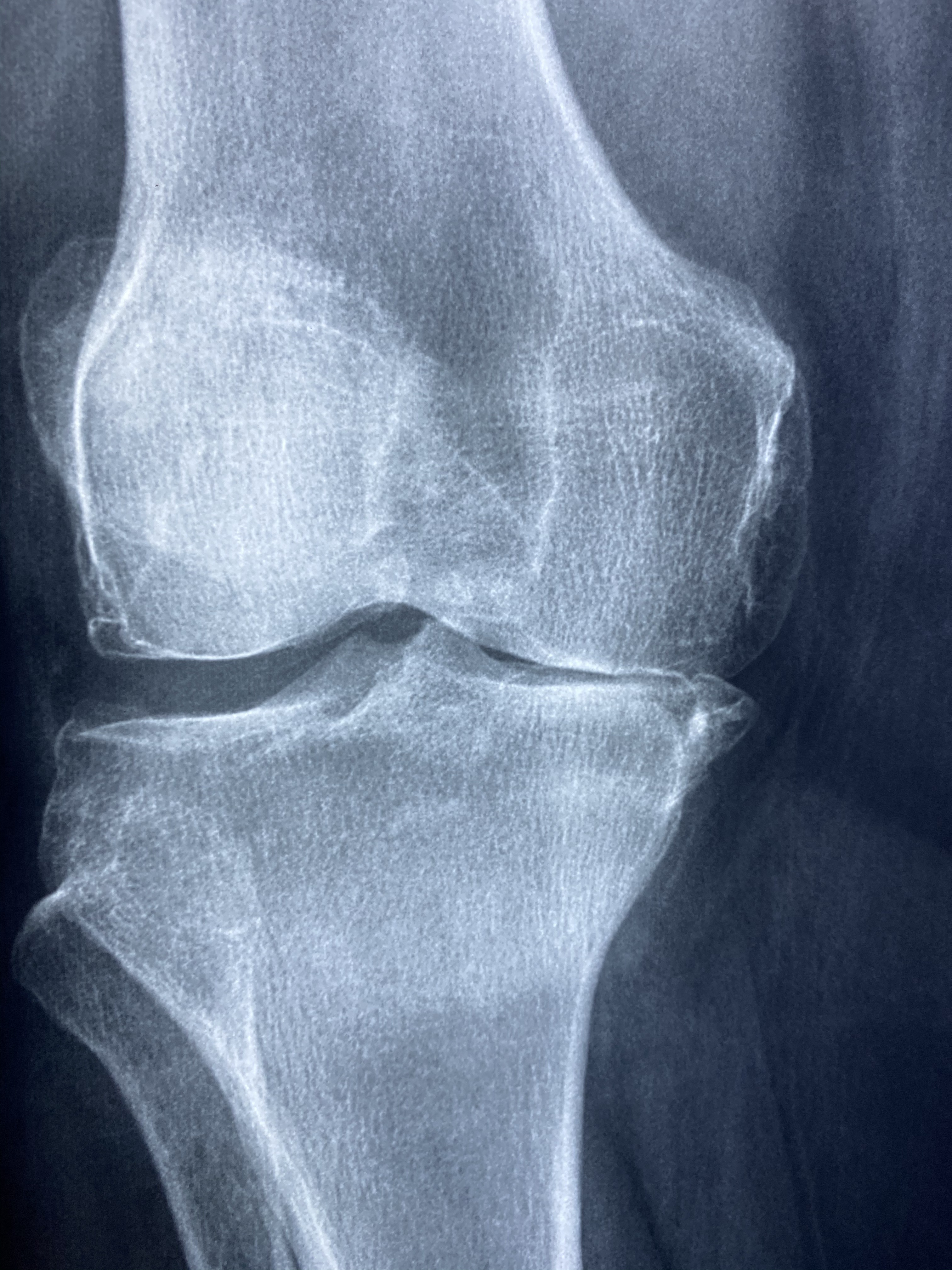
Knee osteoarthritis, or gonarthrosis, is one of the most common forms of osteoarthritis. It corresponds to the progressive destruction of the cartilage in the knee joint, which connects the femur, tibia, and kneecap (patella).
Mechanisms of the pathology
In a healthy joint, cartilage is a smooth, elastic substance that allows bones to glide without friction. In cases of gonarthrosis:
Degeneration: The cartilage loses its thickness, cracks, and eventually disappears in places.
Bone reaction: The underlying bone, exposed, becomes denser and bony outgrowths (osteophytes or "parrot's beak") form on the joint edges.
Inflammation: Although osteoarthritis is mechanical, inflammatory episodes (flare-ups of hydrarthrosis or "synovial effusion") can occur.
Main symptoms
Pain: It is typically "mechanical," meaning it increases with walking, going up or down stairs, and subsides with rest.
Stiffness: Particularly present in the morning (morning stiffness) or after prolonged sitting.
Cracking: Sensation of friction or audible noises during movement.
Instability: Sensation of the knee giving way.
Different types of gonarthrosis
Femorotibial osteoarthritis: Wear between the femur and tibia (often linked to a leg axis problem, such as genu varum or genu valgum).
Femoropatellar osteoarthritis: Wear between the femur and the kneecap (sharp pain when going down stairs or when sitting for a long time).
Expert opinion: Management is primarily based on non-surgical measures (weight loss if necessary, rehabilitation, insoles, painkillers, and injections). Surgery, such as joint replacement, is only considered when medical treatment is no longer sufficient to ensure a good quality of life.

:quality(92):sharpen(0.8,0.6,true)/https%3A%2F%2Forthopedie-zhiti.ch%2Fuploads%2Fpathologies%2Fgemini-generated-image-1c14fr1c14fr1c14-69ea00a2cf373953377496.png)