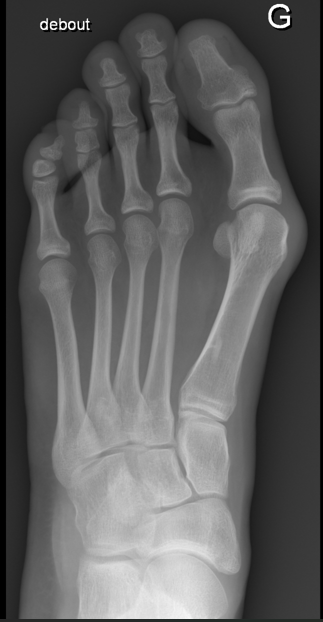
Hallux valgus is one of the most common foot pathologies. While many initially consider it a simple problem of an unsightly "bump," it is a true architectural modification of the forefoot that requires special attention.
The mechanism of deformation
Contrary to popular belief, hallux valgus is not a bony outgrowth that "grows." It is a mechanical imbalance:
The first metatarsal (the long bone of the foot) deviates outwards.
In reaction, the big toe pivots towards the other toes.
The apex of this angle forms what is known as the bunion.
Why does the foot deform?
While heredity plays a key role (foot morphology transmitted by parents), other factors accelerate the process:
Hypermobility: Excessive flexibility of the ligaments that no longer hold the bone in its axis.
Environmental factor: Prolonged wearing of compressive or high-heeled shoes that shift the center of gravity towards the forefoot.
Hormonal changes: An acceleration of the deformity is often observed at the time of menopause.
Warning signs: When to worry?
The evolution is generally slow but irreversible without intervention. You should remain vigilant if you observe:
Localized redness on the bony prominence (sign of excessive friction).
Night pains (sign of joint inflammation).
The appearance of calluses under the sole of the foot, indicating that your weight-bearing is deteriorating.
What options for your feet?
Daily prevention
Before considering surgery, simple solutions exist to stabilize the deformity:
Footwear choice: Prefer flexible materials (soft leather, mesh) without seams at the bunion.
Rehabilitation: Physiotherapy exercises to strengthen the intrinsic muscles of the foot.
Orthoses: Wear night splints or orthopedic insoles to redistribute pressure.
The surgical approach
It is only recommended when pain becomes a daily handicap. Modern techniques (minimally invasive or percutaneous) now allow for much faster recovery than before, with almost immediate resumption of walking in the majority of cases.
Expert advice: Don't wait for your other toes to deform "claw-like" before consulting. An early orthopedic assessment is the best weapon against the worsening of hallux valgus.

:quality(92):sharpen(0.8,0.6,true)/https%3A%2F%2Forthopedie-zhiti.ch%2Fuploads%2Fpathologies%2Fgemini-generated-image-48e67248e67248e6-69ea10b6efce6202846194.png)